To the Sea By Train: Andrew Martin at Oxford Literary Festival.
For writers about railways, nostalgia is a gift that keeps on giving. You may have seen the railway historian Andrew Martin on television presenting “The trains that time forgot – Britain’s lost railway journeys” for the 2015 Timeshift series. In that programme he acted as an affable guide, telling the story of the Flying Scotsman, the Cornish Riviera Express, and the Brighton Belle.
Andrew came to Oxford Literary Festival on Thursday 26th March to talk about his latest book “TO THE SEA BY TRAIN”.
On the screen, he projected the earliest and possibly the most famous railway advertising poster of all – a jolly fisherman in sou’wester, scarf, and wellingtons dancing along the beach under the motto “Skegness is so bracing.” The poster was issued in 1906, and earned its creator the Freedom of Skegness.

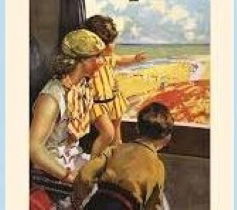
As the 20th century progressed, railway posters began more and more to exploit our propensity to romanticise travelling to the seaside in a railway carriage. They also encouraged a patriotic belief that Britain’s beauty spots were equal to, or even indistinguishable from, destinations on the Continent. The Cornish Riviera Express was sold on the basis that “There is a great similarity between Cornwall and Italy in shape, climate, and (nudge nudge) natural beauties.”
Andrew reminded us that our country offers memorable and spectacular rail trips by the sea. The curving Cornish line to St Ives; the spray-flecked ride as the train passes Dawlish, dives into sandstone tunnels, then heads inland up the estuary at Teignmouth; and the sunlit approach over the bridge to Barmouth.
Many of the resorts which benefitted from arrival of the railways-such as Brighton and Scarborough were formerly stylish spa-towns. But other posters suggest that unfashionable resorts also gained a boost from railway publicity. “Cleethorpes – it’s quicker by rail” “Come to Cromer where the poppies grow.””Herne Bay on the Kent Coast” and “Bridlington, on the Yorkshire Coast” and my own favourite “Grange-over-Sands, the Naples of the North.”
Andrew Martin’s tone when recounting this “Golden Age of Railway Travel” is distinctly elegiac. He blames Doctor Beeching (don’t we all) who closed the lines to many pretty resorts, such as Lyme Regis, and who planned to close every single station on the Isle of Wight. As road travel replaced the train, holidays became more individual affairs, and something which brought people together was lost. The rail excursion to the seaside had been a joyful exercise in togetherness for urban dwellers in the early and mid twentieth century. In Wakes Week, the textile factories shut down and special trains took the people from the industrial North to Blackpool, Morecambe, or Scarborough. A member of the audience also recalled the Engineering Works at Swindon closing down to allow the workers a week’s holiday in Weston-super-Mare. These shared experiences on the holiday specials were contrasted with the less sociable experience of travelling by car.
And how much more pleasant it is than travelling by plane!
Andrew Martin is a fund of wry anecdotes, and it was most enjoyable to hear a railway historian give us the benefit of his exhaustive research and years of enthusiasm.
“To the sea by train” is published by Profile books and available in hardback for £18.99.
All books featured in the Oxford Literary Festival are on sale in Blackwell's and there are often signed or discounted copies available.
https://blackwells.co.uk/bookshop/search/
https://oxfordliteraryfestival.org/