Dazzling Tchaikovsky and Prokoviev from Oxford Philharmonic with Maria Dueñas
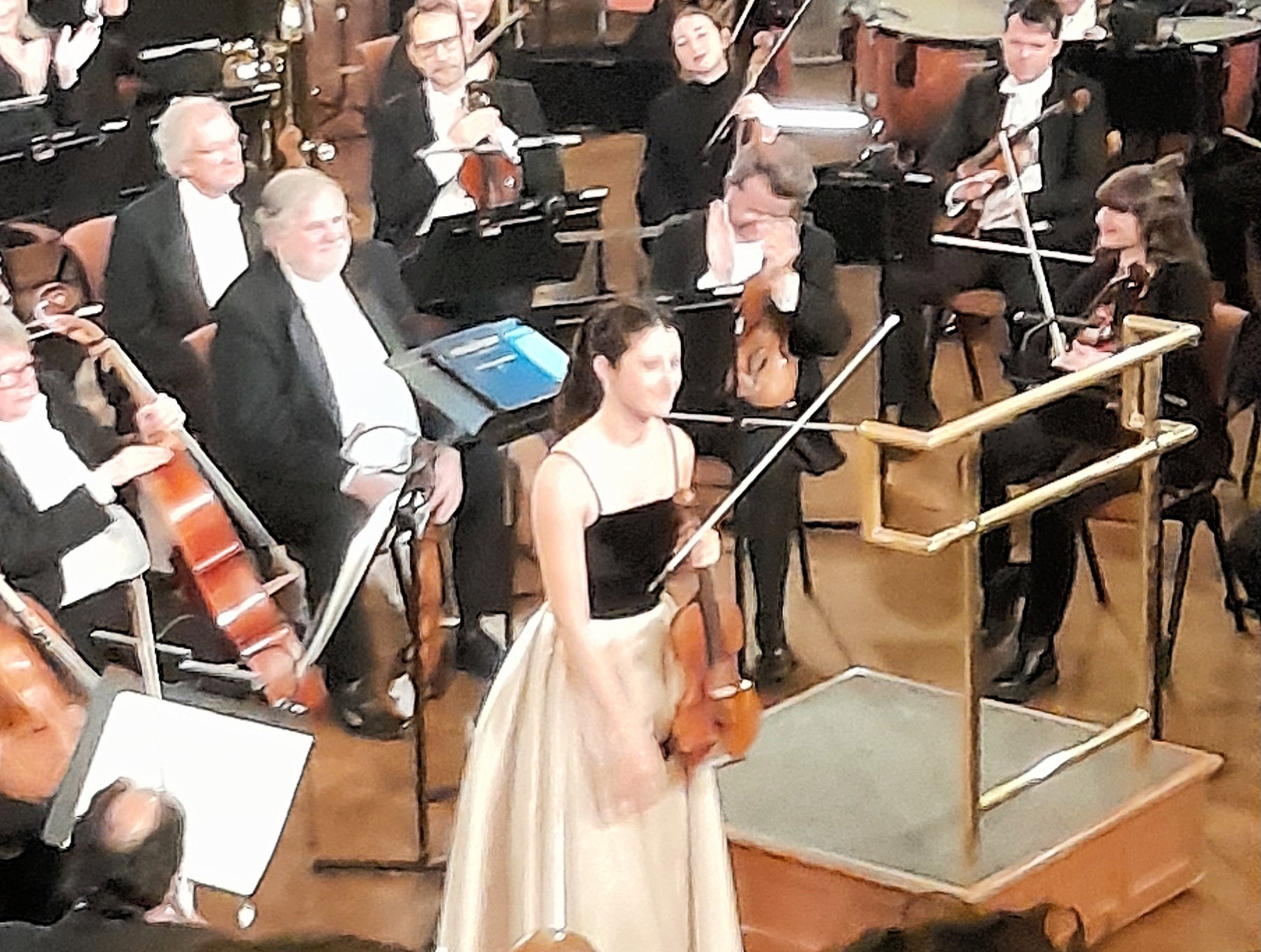
Oxford is very fortunate to have its own resident Philharmonic Orchestra, giving concerts of this calibre, under its conductor Marios Papadopoulos .
Last night's concert at the Sheldonian was both exciting and impressive. It opened with a work unfamiliar to many, an overture by Doreen Carwithen (1922-2003) entitled ODTAA (One Damn Thing After Another). Composed in 1945 it is assured and inventive, epitomizing that moment of confidence, victory and optimism. Carwithen is a composer whose numerous works are now starting to be performed more widely. The overture was conducted by guest conductor Cayenna Ponchione-Bailey, whose enthusiam was infectious.
This was followed by Prokoviev's Violin Concerto no.1 in D major with Marios Papadopoulos taking the baton. This concerto, written in the fateful year 1917, is not one of the most popular in the repertoire, being both unconventional and fiendishly difficult. Distinguished young Spanish violinist María Dueñas was more than equal to the challenges of this extraordinary work, which defies expectations in many ways. It starts by letting the soloist just glide into the pensive, meditative opening. From there, we are soon carried away into a frenetic whirlwind demanding immense virtuosity on the part of the soloist. Dueñas gave us an astonishing flow of musical eloquence, fire and fury, before the movement ended with a mysterious, ethereal soaring into the sonic stratosphere. The second movement, a Scherzo, is agitated and energetic, a helter-skelter ride with the vigour of a Cossack dance until it brings us to a sudden, abrupt ending.
The third movement at last adopts a slower pace and after some magical harp ripples the violin gives us a prolonged lyrical soliloquy, until it seems to be a soul floating free, aloft. And there this very unconventional work leaves us.
The second half of the concert consisted of Tchaikovsky's Fifth Symphony, a more familiar work that was given a powerful and profound performance. It starts with the sombre, funereal tones that Tchaikovsky called the "Fate" theme, but then we are carried far away, by music that gives us a feeling of going back in time like a flashback in a story, to a time of youthful idealism, with sylvan, pastoral sounds, and a lilting dance. It is a mood of enthusiasm and aspiration. The second movement opens with that enigmatic horn melody that is taken up by clarinet, then oboe, and then strings. Despite the rude interruption of that "fate" theme, it rises to an exulting climax.
The third movement gives us some respite from intensity, and evokes the light, frisky ballet music at which Tchaikowsky excelled. Even here the "fate" theme casts its shadow towards the end, but in the final movement Tchaikowsky transposes it into a major key and then embarks on a movement in classical sonata-form that is a tour-de-force, combining passion with a disciplined structure in the most resolute way. It is grand and noble, music that refuses to yield to despair, ends with a defiant Presto and is ultimately life-affirming.
At the end of this performance, many of the audience gave a standing ovation, which was very well deserved. It was a great way to spend Guy Fawkes Night - all the fireworks were here.
Oxford Philharmonic will be giving a series of Ertegun Concerts, supported by the generosity of the Ertegun Trust. And during 2027 they will be presenting an entire Beethoven Festival, to commorate the 200th anniversary of the composer's death. To find more details of these events, see
https://oxfordphil.com/events/?