Electrifying. Glass and Gershwin at Oxford Chamber Music Festival.
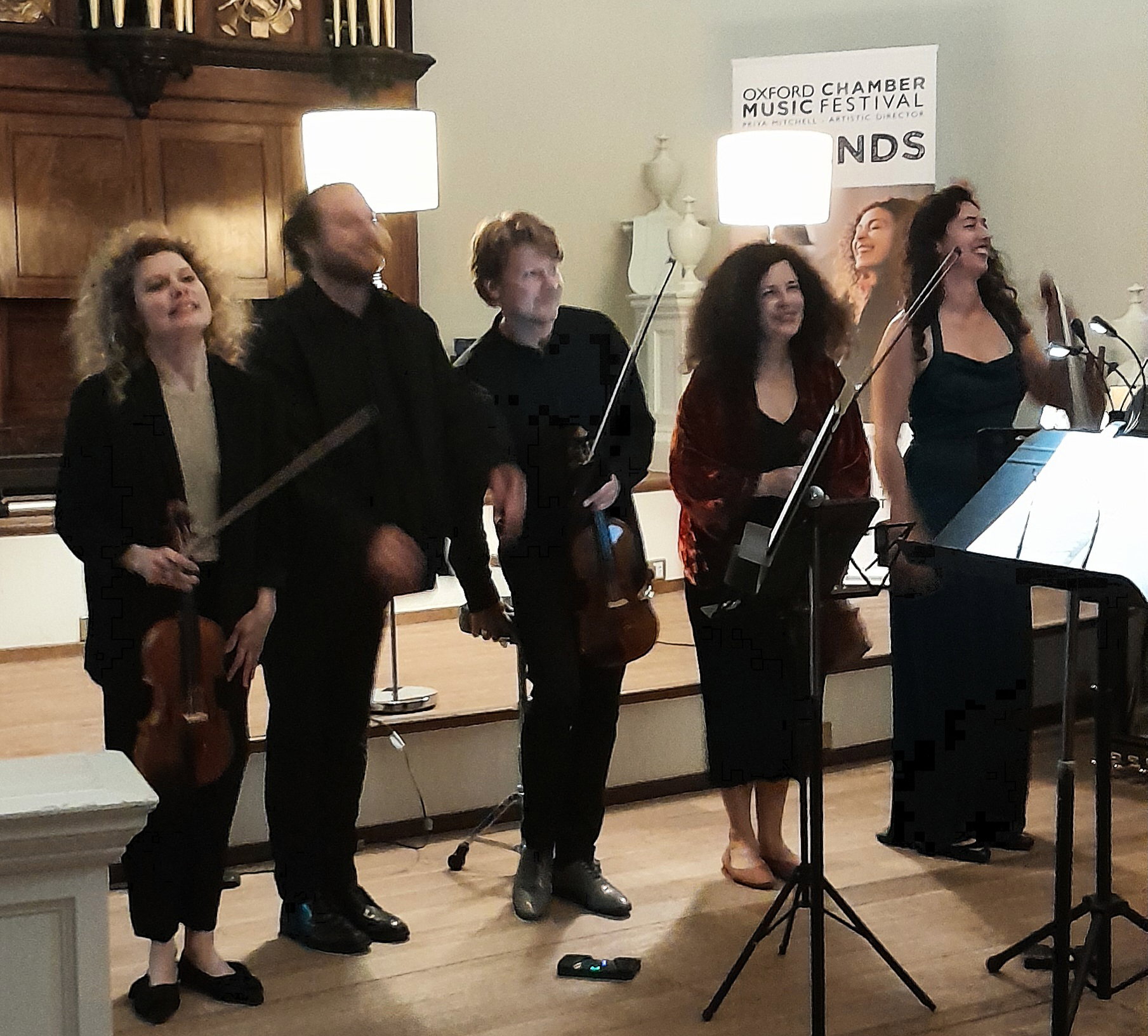
This years 's OCMF takes an American theme, and Wednesday evening's concert in the Holywell Music Room "Loops and Lullabies" featured several modern American pieces that were unfamiliar to many in the audience, and an exciting revelation.
Priya Mitchell was joined by players of Meta4, the distinguished Finnish string quartet, consisting of Minna Pensola (violin), Antti Tikkanen (violin), Atte Kilpeläinen (viola), and Tomas Djupsjöbacka (cello). Other performers this evening included Adrian Brendel (cello), Meghan Cassidy (viola), Sam Cole (violin), Jordi Carasco-Helm (double-bass) Janne Thomsen (flute) and Dirk Mommertz.
The latter opened the programme with The Star-Spangled Banner, in Rachmaninov's grand and magisterial piano arrangement.
We then heard a movement from Philip Glass's String Quartet No. 3. This piece, originally written for the film 'Mishima', offered delicate, lacey textures, mysterious and whispering like willows. Glass, notorious for using repetitive motifs, understands how they can create a hypnotic and eventually soothing effect. Glass is now established as a grand old man of US music, with an immensely long list of major compositions to his name. Being an avant-garde composer is not an easy career and in the Land of the Free at one time he had to work as a taxi-driver, despite which he has written dozens of operas and film scores and is now a household name. There are many jokes about him, which is an accolade. (Knock-knock. Who's there? Philip Glass...Philip Glass...Philip Glass).
Osvaldo Golijov's Lullaby and Doina for strings and clarinet draws on memories of his Jewish upbringing in Argentina. It starts as variations on a Yiddish song, then breaks in with a doina, a type of Romanian gypsy dance with oriental roots. He is merging the idioms of two communities that were persecuted during the 20th century. It rose to a frenetic climax intensified by syncopation.
George Gershwin's Suite from Porgy and Bess for piano and violin is a wonderful example of how jazz idioms can survive being written down and a sympathetic performer can reproduce the impression of improvization, doing unorthodox and startling things on the instrument. Minna Pensola with Natacha Kudritskaya at the piano, gave a sizzling performance, brash, gutsy and full of surprises till the last moment.
John Adams' Shaker Loops for string septet is a substantial four-movement work that took us on a long journey through strange sound-landscapes. There is much use of tremolando and ostinato in the central nocturne-like section. Then the music gradually grows and morphs into a tremendous frantic dance, until it seems to burst into leaping flames. Quite extraordinary.
In the second half we had the pleasure of hearing Priya Mitchell play the Dvořák Sonatina, a lyrical piece (which should surely be called a Sonata). This was full of warmth and tenderness -- her tone is like maple syrup and double cream. She has always played passionately and now she plays with growing authority and wisdom.
Mats Bergström played Villa-Lobos's 2 guitar preludes, virtuoso pieces that make the instrument sing in a haunting fashion. He was then joined by Priya Mitchell and Natacha Kudritskaya for Astor Piazzolla's Histoire du Tango for violin and guitar, a mischievous piece in the Latin American style.
The final piece, Waxman's Carmen Fantasy, on themes from Bizet, was a sophisticated 20th-century take on melodies from the beloved 19th-century opera.
Altogether it was an evening of electrifying music, as we would expect from this gem of a music festival, founded and directed by Priya Mitchell. It draws together musicians from far and wide to enjoy working together and pushing the boundaries.