The Rediscovery of Charlotte Sohy. A neglected French composer.
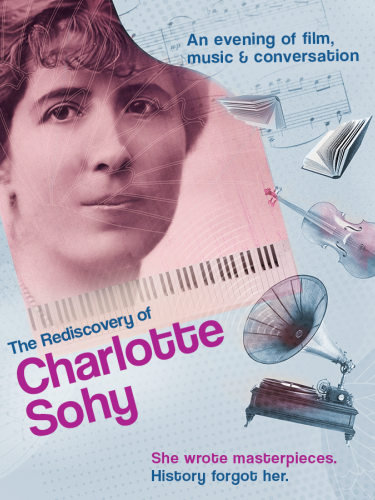
This exciting event at the Maison Française d'Oxford introduced the audience to a talented composer most people have never heard of, and who certainly deserves recognition: Charlotte Sohy (1887-1955).
The evening consisted of a film about her life, followed by a discussion led by Sohy's great-grandson Matthias Weber, who has researched her life and music, with Laurence Uebersfeld and Peter Quantrill.
After the interval we were given a fine performance of two of Sohy's chamber works by Gina McCormack (violin), Adrian Bradbury (cello) and Reiko Fujisawa (piano), who has taken a leading rôle in gaining recognition of Sohy as a composer in recent years.
It was clear from the soundtrack of the film, the UK premiere of "Charlotte Sohy: la consécration d'une composotrice" which includes extracts from performances of her music, sometimes powerful, sometimes enticing, that she is a significant rediscovery for the musical world. She was capable of writing for full orchestra as well as piano and intimate ensembles. Thirty-five of her compositions survive, including a symphony and an opera.
In many ways Sohy had a fortunate upbringing. Born into a wealthy family, brought up in Paris, a capital of European culture in the Belle Époque, she had an excellent education, and benefited from a sympathetic woman music teacher, Mel Bonis, who encouraged her to compose. She managed to get into a music academy, the Schola Cantorum, and when she married (which might have been the death knell of many women's career aspirations) her husband, Marcel Labey, a composer himself, encouraged her to carry on doing so, despite the fact that they eventually had seven children. He saw her as a kindred spirit, not a rival.
During WW1, when Marcel was called up and seriously wounded, Sohy wrote her Great War Symphony, in C sharp minor, a dark, sombre work, mourning the tragedy that cost so many lives. It was not performed until 2019, at Besançon.
Her opera, Astrid, was written in 1931, and to her great joy finally performed in 1948, a few years before her death, but never since.
The pieces we heard were impressive, sophisticated post-Romantic in style and very attractive. They reminded me above all of Ravel.
The Piano Trio opus 10 (1931) opens with an unstoppable, passionate flood of melody in a minor key, and effortless counterpoint. The second movement, in the major, reflective and pensive, lets each instrument take its part in the conversation. The concluding Allegro contrasted spiky, agitated motifs with a dreamy theme rippling like water.
The Petite Suite opus 13 conjures up the world of childhood. Sohy, who taught the piano under the name of Mme Labey, also enjoyed educating her own children, and the mood is idyllic and nostalgic. It ends with a vigorous folk-dance that everyone was humming as they left the room.
Charlotte Sohy is indeed an exciting discovery. I look forward to hearing more of her works, and playing her piano compositions if and when the scores become available.
The Rediscovery of Charlotte Sohy. An evening of film, music & conversation Maison Française d'Oxford https://share.google/sIRjllZvqrRYY5f4i
Maison Française d'Oxford. What's On.
https://share.google/RqFyvayyYNZ98ijwK
Join Reiko's mailing list. Be the first to know about news, concerts and ticket offers:-