Thrilling Macbeth at Longborough Festival Opera.
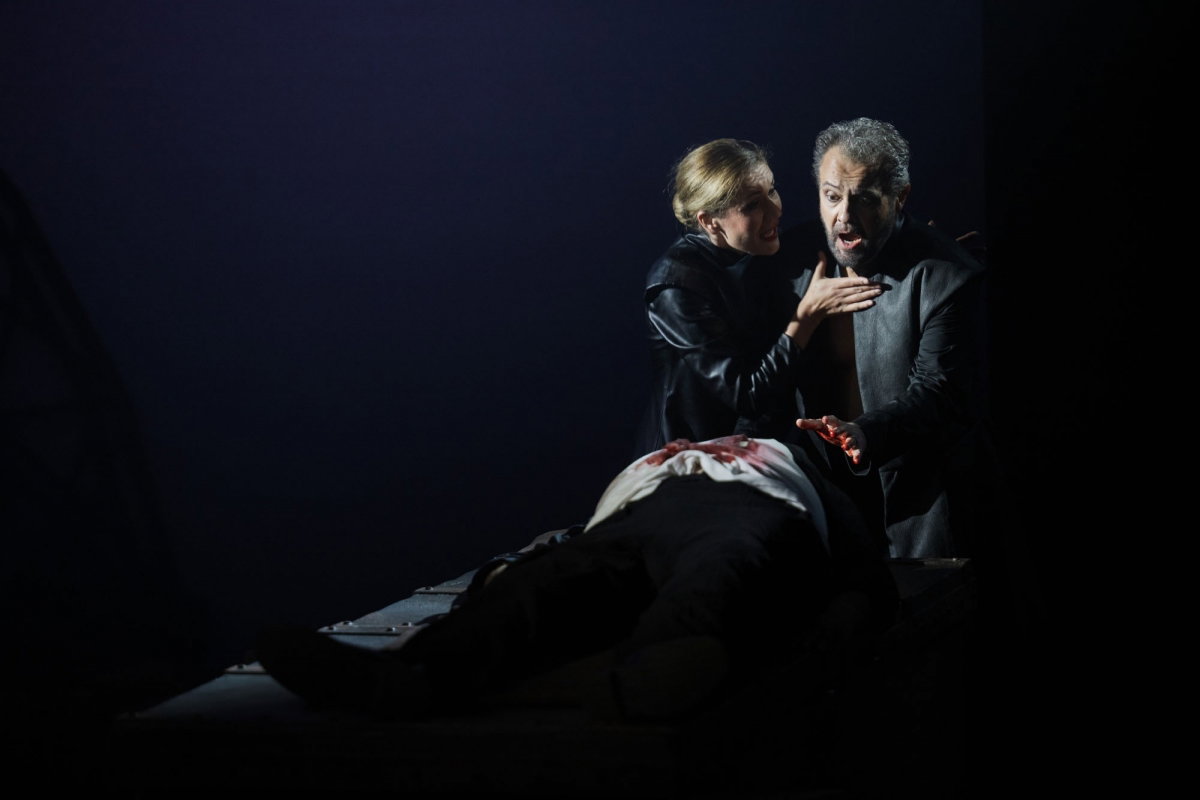
There are only three performances left of this production, on 11th, 14th and 16th July, with limited availability, so before you read to the end of this review be sure to book tickets, or you might be too late.
Verdi's Macbeth is a dark, blood-curdling opera that takes the sinister and diabolical elements of Shakespeare's play and transforms them into music that is intense, frenetic and menacing. Its urgent rhythms, galloping pace and driving energy are well displayed in this production, directed by Karolina Sofulak and conducted by rising star Nil Venditti, who is Principal Guest Conductor of the Royal Northern Sinfonia.
While the production is visually dark, it is not stark, using colour and movement to tell the story in multiple ways.
Macbeth in this opera is far easier to persuade to crime than he is in Shakespeare's play. Sung powerfully and splendidly by Mark Stone (baritone) he seems as infatuated by the witches' promises as his wife is, although he is seized by horror and remorse very soon and cannot bear to return to the room where the dead Duncan lies.
It is a good production idea to show Lady Macbeth as being embroiled with the witches - she has been called a "fourth witch" in the play. Ukrainian soprano Viktoriia Balan did justice to this complex rôle, ruthless one minute, blandly hypocritical the next, and reduced to a wreck in the sleep-walking scene - a scene that made the reputations of many great actresses from Sarah Siddons to Ellen Terry.
The pace of the opera slows a bit in Act IV, which opens with the chorus "Patria Oppressa!" (ably performed by Longborough Community Chorus) lamenting the ruin and suffering of their native land, Scotland, under Macbeth's tyranny. It is reminiscent of the chorus of the Hebrew Slaves in Nabucco, and like that has links to the Risorgimento.
Verdi was always a supporter of Italian national liberation. Its first efforts failed in 1848, shortly after he wrote the first version of this opera. By the time he revised it in 1865, unification was not yet complete and the whole of the Veneto was still under Austrian rule until 1866. It was a nice coincidence that his name formed an acronym of Vittorio Emmanuele Re D'Italia - the first constitutional monarch of a unified, liberal Italy, and VERDI was scrawled on walls as a cryptic motto.
For us today the chorus has many contemporary resonances. With a Ukrainian soprano performing a leading rôle, we are reminded of the terrible ruin and suffering of that country. And there are many other groups of exiles (and non-exiles) who have to mourn tyranny and persecution in their countries.
Act IV continues in sombre mood as Macduff (Jung Soo Yun, tenor) mourns over the murder of his wife and children in an anguished aria that rightly won applause. The sleepwalking scene is eerie and melancholy. Lady Macbeth is not yet dead, yet she has become like a ghost, an apparition walking in a castle, forever recalling a scene of horror.
Then the furious pace resumes as the exiles, led by Macduff and Malcolm, storm Dunsinane castle and overthrow Macbeth.
The audience was very appreciative and there were many "bravos" amid the prolonged applause.
Belief in witchcraft led to the persecution of many innocent people. But in its other themes - ambition, lust for power, the tragedy of a man, great in some ways, who destroys himself and wrecks his country out of a sheer, all-consuming obsession with power - then, finally the human urge for liberation, this story is timeless and contemporary, and the music is in every way worthy of it.
Five stars *****
https://lfo.org.uk/opera/macbeth